
The Ice Was The Whole Point (Or: A Cautionary Tale About Comfort)
There's no earthly way of knowing. Which direction we are going. There's no knowing where we're rowing. Or which way the river's flowing.
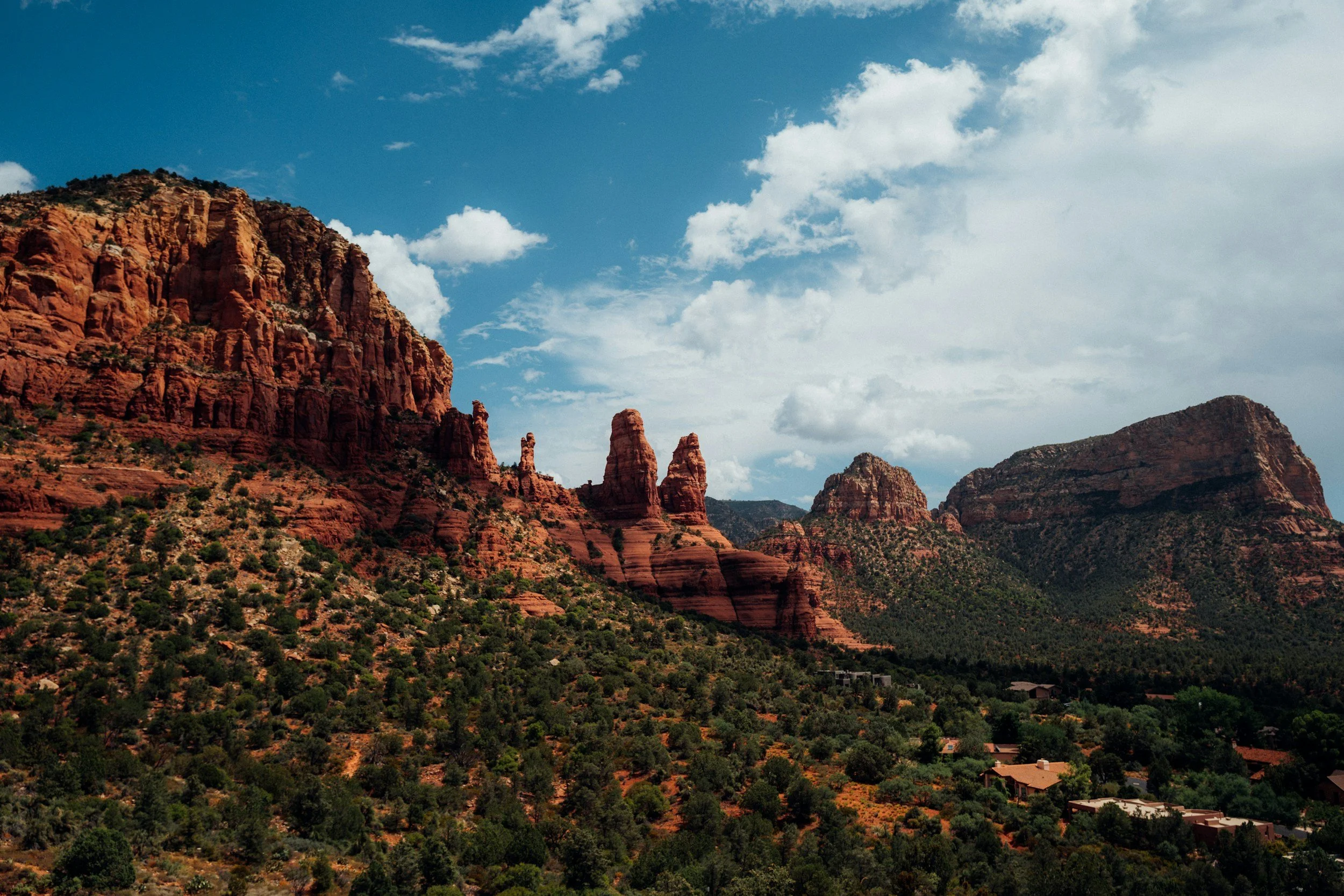
In a whirlwind of 24 hours of delayed travel, I'm back at my computer screen after a weekend in the Red Rocks of Sedona.
Multiple times a year, I take a small group of intrepid humans to remarkable places to do remarkable things. The nature and degree of such things is not made available to them until they get there, and that creates all the fun.
An invite goes out to a list of people who are part of a network we call FirePits. A curated group of humans who have heeded the call in the past. This group of humans has demonstrated that they are willing to put aside the desire to know, and instead start first with do.
When new applicants join the group, the existing members get to screen them for two things: their respect for curiosity, and their degree of vulnerability. Two very rare attributes in a world such as today's. Most people are the adverse—obsessed with certainty and closed off in order to project confidence.
The Problem on the Mesa
As we crested the mesa in the back country of the Coconino Plateau, I knew we had a problem.
Despite copious research and preparation, it was still, after all, late February in high country. And therein lies the problem.
Ice. And a lot of it. And in a place you don't want it to be. A 2,000-foot descent to the valley floor. This might be a sled ride.
This is where it began for me. My work. Because what I immediately felt was responsibility, but really what I was feeling was inferiority. I was feeling shame and disappointment in myself.
How could I have missed this? Now I've put the whole group in danger. I should shut it down. Concede defeat. Who do I think I am?
This litany of self-defeat went on. But the truth was we had just finished the highest climb of the objective, and we were only a few miles in, with 20 more to go. I stood there a moment considering what defeat really looked like.
That's when it started to reveal itself to me. Perhaps I should take my own medicine.
Nature Doesn't Care About Your Plans
This ice, while precarious, became a lucid point in the story. A story of chaos and the value of nature.
I was attempting to take people into the wild to face a challenge, but at the same time, I was trying to strip away any uncertainty from myself. Well, in that moment, nature reminded me I don't get a vote.
I only get a choice.
This is what Dr. Paul Conti calls Agency—not the belief that you can control everything, but the recognition that you can influence outcomes and take responsibility for how you respond. Agency isn't about eliminating uncertainty. It's about choosing how you meet it.
We moved forward.
I was about 20 minutes or so ahead of the main group. I hold the pace for the event. Sam held the group with him. I decided that I would traverse the ice and trail and make a call from there. I was much more comfortable in this and had a lot more experience than them.
So I moved forward.
The ice was challenging but not impossible. It was simply an unexpected variable. And as the group emerged at the checkpoint at the valley floor, their faces are not something I will soon forget.
I could hear them laughing before I saw them.
That's when I knew I made the right choice. That's when I knew the ice was the whole point. Metaphorical or otherwise.
The Comfort Delusion
In life, we love to pretend we step into the wild. Into the unknown and uncertain. We love to cast ourselves as the main characters of our movie, and we script ourselves in our mind like the brazen hero.
But the real truth is, we are anything but.
We always iterate for comfort.
And then nature comes along and reminds us what a mistake that is.
We fail at the margins of our exposure.
Read that again.
Our greatest indicator of success is the degree to which we have been subjected to challenge, uncertainty, and discomfort.
Comfort, then, is not just a survival quirk. It's a failure mechanism.
And yet, we all romanticize it.
If I get through this, it will get easier.
If I work for 40 years, then I can relax.
If I just do this, I'll get what I want.
This is what I call the Comfort Zone quadrant in the Stress-Traction Matrix—low traction, low stress. Safe but stagnant. Not challenged, potential untapped, coasting, risk-averse. The feeling is comfortable but unfulfilled. Safe but bored.
It's the most dangerous place to live because it doesn't feel dangerous at all.
The Wonka Warning
Which brings me to another Wonka quote:
But Charlie, don't forget what happened to the man who suddenly got everything he ever wanted... he lived happily ever after.
This might read as romantic soliloquy to comfort.
But to me it reads as a cautionary tale.
When Wonka gifts the Factory to Charlie, he knows he's moving him from abject poverty to lavish luxury. He knows he changed the boy's entire life, and that's what he's warning him of. The risk here being that the Factory has come easy to Charlie, and if he's not careful, he won't live happily ever after at all, but instead partner with desire to chase other metaphorical factories.
Which, in my experience, so many of us are guilty of.
I meet daily with people who have everything they once wished for, but rather than living in splendor, they are absolutely suffering in desire of more.
This is what happens when Gratitude is compromised—when you lose the capacity to appreciate what you have and acknowledge what's working. When presence gets traded for future fixation. When abundance mindset collapses into scarcity despite external abundance.
Dr. Conti identifies Peace, Contentment, and Delight as the hallmarks of mental health. Not achievement. Not comfort. Not certainty. The goal isn't to eliminate challenge—it's to meet challenge from a place of wholeness rather than deficit.
The people I work with who have "made it" often can't feel any of it. There's a numbness. A flatness. An inability to experience the contentment that should accompany genuine success. They keep chasing factories because sitting with what they've accomplished feels intolerable.
And they wonder why they're not happy.
The Response-Ability Curriculum
As the group descended into the valley, I knew they had gotten a potent dose of exactly what I had prescribed to them. Unknowable environments and composure under chaos. To which they had not only prevailed, but excelled.
And the hits kept coming. I'd love to say the ice was the only unexpected challenge. But it wasn't, and that's the whole point of FirePits.
To face adversity, and to do so in an unforgettable environment, but to do it with a group of unforgettable people.
Which is why the motto for FirePits is "People like us do things like this."
It's not that they are avid endurance athletes, outdoor adventurers, skilled-niched humans. It's that they are people who don't put knowing in the way of knowing. They are people who value "response-ability"—as in, their ability to respond.
And they cherish the ability to grow a skillset of exposure that affords them an ever-expanding ability to respond to what life throws at them. And it's easy to do when they know they have each other.
This is the science behind experiential transformation. Why experiences transform when information doesn't. There are three integration elements that make this work—physical involvement that engages the body, emotional intensity that creates chemical change, and meaning and purpose that connects to something larger than yourself.
Reading about resilience doesn't build resilience. Facing ice on a mesa builds resilience.
The Secret That Isn't Endurance
For most people who hear about this "secret group" (that I'm ironically talking about—sorry, Fight Club) they mistake it for something that looks like endurance work.
It's not. It's exposure work.
Sure, I use nature as a stimulus to provoke exposure. But they also use each other. Because what happens in the wild on the trail often pales in comparison to the challenge around the fire. It's here where they go deep, and for some it's a first time ever. But the container we bring together makes all this possible.
The FirePit experience has four phases.
The first phase is arrival and orientation—creating safety, establishing the container, beginning relationship building. The second phase is foundation building—deepening relationships, beginning vulnerability practice, creating shared experience. The third phase is the FirePit intensive itself—the fire circle, structured deep sharing, individual commitment and declaration, community witness for change. The fourth phase is integration and closure—processing insights, planning practical application, celebrating transformation.
But here's what most people don't understand: the physical challenge is just the doorway. It creates the conditions for the real work—the vulnerability, the truth-telling, the letting go of the masks we wear everywhere else.
What Comes Out the Backside
And what comes out the backside on Sunday as they head to the airport is people changed forever.
They faced uncertainty. Encountered doubt. Partnered with belief. Overcame adversity. And arrived at proud.
And that's the entire curriculum of our FirePits.
This last weekend in Sedona was a master class. It was the hardest event in our history, and not simply physically.
My Own Work
I personally worked through so much of my own stuff.
I arrived at this event on the heels of doing my own work. And part of that work was the arrival of awareness of my performative nature. I think the world only values me for the resources I provide, and because of that, I spend a great deal of effort projecting these resources to people. This is great for them, but not for me, as it leaves me feeling disconnected.
This is what I write about in the Two Containers Framework. The Structure of Self—your character structure, defense mechanisms, unconscious patterns—is the therapy domain. The Function of Self—your behavior, action, salience, self-awareness—is the coaching domain. But they're connected. My performative pattern wasn't a coaching problem. It was a Structure of Self pattern that showed up in my Function of Self.
So for this event, I said I would go in and surrender. I would protect and lead, but I would do so vulnerably and curiously.
And wouldn't you know it, nature gave me a potent dose.
I will always say, "the trail provides"—as in, nature always gives you exactly what you need, not always what you want.
And when I faced that ice, I had my own things to work through. And that I did.
The Point Where Both Threads Meet
Out the backside I emerged way more connected to this group than I could have ever imagined.
And this is where both threads of this story converge on a single truth:
Connection requires vulnerability. Vulnerability requires exposure. Exposure requires the willingness to choose curiosity over certainty.
The ice was the whole point. Not because it was hard—because it was unknown. Because it couldn't be planned for. Because it required me to stop performing and start choosing.
The people in FirePits aren't drawn to suffering. They're drawn to aliveness. And aliveness requires the willingness to face what you can't control, with people who will witness your struggle without judgment.
We fail at the margins of our exposure. Which means we grow at the margins of our exposure.
The question isn't whether you'll face uncertainty—you will, whether you choose it or not. The question is whether you'll develop the response-ability to meet it, and whether you'll have a community to meet it with.
The Two Warnings
So this piece carries two warnings, really.
The first is the comfort warning. The belief that if you just achieve enough, you'll finally be able to relax. That safety equals fulfillment. That the goal is to eliminate challenge. This is the path to the Comfort Zone quadrant—safe but stagnant, comfortable but unfulfilled, alive but not living.
Wonka wasn't celebrating Charlie's windfall. He was warning him. The factory that comes easy creates the expectation that all factories should come easy. And then you spend your life chasing factories instead of living.
The second is the certainty warning. The belief that you can research your way out of risk. That you can plan your way out of chaos. That if you just know enough, you won't have to face the unknown.
This is the illusion I was operating under when I saw that ice. I had done copious research. I had prepared extensively. And I was still faced with something I couldn't have predicted. And in that moment, I had a choice—retreat to what I knew, or advance into what I didn't.
The ice was the whole point.
The Invitation
If you've read this far, something in you responded.
Maybe it was the idea of facing challenge with a community of people who won't let you hide. Maybe it was the notion that comfort might be the thing holding you back. Maybe it was the recognition that you've been chasing factories when what you actually want is to feel alive.
FirePits isn't for everyone. It's for people who are willing to put aside the desire to know and instead start first with do. People who value curiosity over certainty. People who understand that response-ability is a skill that must be developed through exposure, not just studied in theory.
If that sounds like you, reach out. The next one is coming.
Because here's what I've learned: You can read about resilience forever. You can study transformation. You can plan for uncertainty.
Or you can put yourself in a position where nature gives you exactly what you need—not always what you want—and discover what you're actually capable of.
The trail provides.
Now go be great.
Frameworks Referenced:
Stress-Traction Assessment - Understanding the Comfort Zone quadrant
The Two Containers - Structure of Self vs. Function of Self
Agency and Gratitude - The foundational pillars of mental health
Immersive Experience Design - The four phases of FirePit transformation
Enough-ness Philosophy - Awakening vs. consumption
Response-Ability - The skill of meeting uncertainty
Interested in FirePits? Apply here to be considered for the next event. Existing members screen all applicants for curiosity and vulnerability. People like us do things like this.